Controlled growing
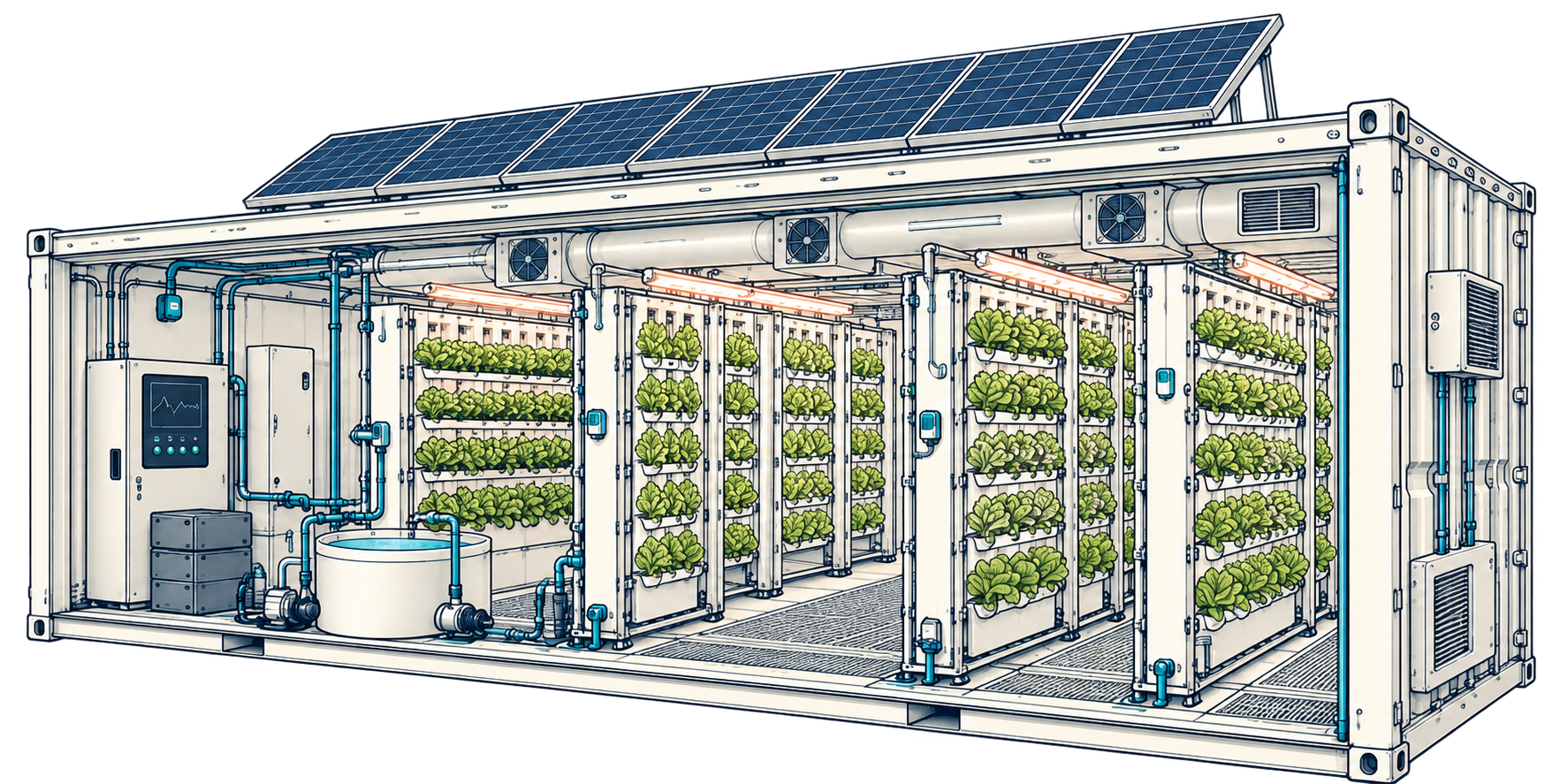
A modular growing environment will support crop trials with carefully managed light, temperature, humidity, and other conditions.
CROP + ENVIRONMENTA more resilient way to grow / Trinidad & Tobago
Renewable energy, intelligent systems, and agriculture—designed together for food production in a changing climate.
Island food systems face pressure from imports, climate extremes, and unreliable or costly energy.
The question guiding our work
Future Fields will investigate a renewable-energy-powered, controlled-environment farming system. The project combines crop science, engineering, and AI-supported monitoring to learn what works in Caribbean conditions—and what it would take for farmers to use it.
Food resilience + energy resilience + practical adoption
One connected research system
A modular growing environment will support crop trials with carefully managed light, temperature, humidity, and other conditions.
CROP + ENVIRONMENTGeneration and storage will be designed alongside the farm to study reliability, energy demand, and operation where grid access is constrained.
GENERATION + STORAGESensors, controls, and AI-supported tools will help the team track crop performance, detect issues, and refine operations from real data.
SENSING + DECISION SUPPORTInitial crop study will focus on onion and garlic, with final requirements shaped by farmers and agronomic research.
Built with the people who might use it
At the University Field Station, the team plans to design and test a demonstration system over a 36-month project. Farmer input will shape requirements, crop choices, and measures of practical value. Experimental cycles will then inform engineering, growing protocols, and guidance for future adoption.
The people behind Future Fields
Faculty of Engineering — energy systems, automation, sensing, and control.
Artificial Intelligence Innovation Centre — software, intelligent monitoring, and system integration.
Faculty of Food and Agriculture — crop selection, growing protocols, and evaluation.
Farming Groups Association — farmer perspectives, practical feedback, and pathways to adoption.
From research to usable knowledge
Demonstrations, training, and practical guidance to assess whether this kind of system fits local needs and resources.
Evidence toward more consistent local production and reduced exposure to climate and supply disruptions.
Measured results on crop performance, energy use, reliability, and costs to guide future projects and policy.
These are intended outcomes. Performance and feasibility will be evaluated during the project.